Set the Result
You tell your coach the result you’d like. Together you drill down to make it specific. “I want to sleep better” becomes “sleep eight hours, starting at a consistent time.”
Helthy is a habit coaching program and an app that together make a healthy lifestyle attainable and sustainable. Grounded in behavioral science, Helthy guides you to habits that will make you feel better, look better, and live longer.
You know your lifestyle matters, and you’ve resolved to make some changes. Maybe it’s eating better, exercising regularly, or sleeping deeper. You know what you should do, but getting started and staying consistent is a struggle. You wish you had the discipline, but life keeps getting in the way.
What if you could design a healthy lifestyle that runs on autopilot? No reliance on willpower; doing the healthy thing is just what you do, without thinking. And because you do it consistently, it has a real impact on your health. That’s the power of habits that work for you, rather than against you.
The Helthy Habits Coaching Program gives you the tools to build habits that stick. In 30 daily online lessons, you’ll learn practical skills based on behavioral science research. Not motivational, feel-good platitudes, but skills you can put into action immediately to make lasting changes.
But lessons alone don’t build habits. There will be barriers, and it takes effort before habits become self-sustaining. So in the Helthy Habits Coaching Program, you work one-on-one with your coach to get through them.
Each lesson ends with a short challenge, so you practice the skill right away.
Six one-on-one consults to apply the methods to your own life, get direct feedback, and work around barriers.
Set up your habits and reminders, track your progress, then review and refine.
Have questions? Book a free intro call.
In this program, you’ll learn how to:
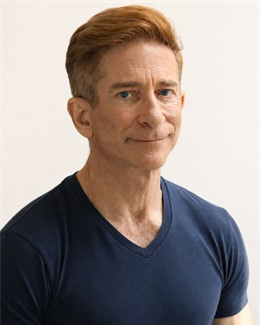
Howard practiced as a physical therapist and health educator for 18 years, then spent more than 20 as a design lead in health tech. He has a bachelor’s degree in psychology and a long-standing interest in research on habit formation. Across his clinical work and his own self-experiments, he kept finding the same thing: what closes the gap between knowing and doing is habit, not more information. Howard is the founder of Helthy, and he leads development of the app that accompanies this program.
Ready to turn your resolutions into habits? Book a free intro call to talk through your goals and see whether the program is a good fit.
The Helthy Habits Coaching Program can be run as a workshop for your members. They follow the 30 daily online lessons, use the Helthy app, and receive support in live group sessions and private coaching. When showing up becomes a habit, members stay part of what you’ve built.
If you run a gym or lead a community, book a workshop call to talk through what would fit your members.
The companion to the Helthy Habits Coaching Program, with more to come. It holds your habits and setup plan, reminds you at the right moment, and tracks your progress.
Helthy works differently from other apps. Trackers measure, then leave you to figure out the rest. Streak apps count, but don’t help when you stall. With Helthy, you and your coach work out what to change and how to get past your barriers, and the app helps you lock in new habits until they’re automatic.
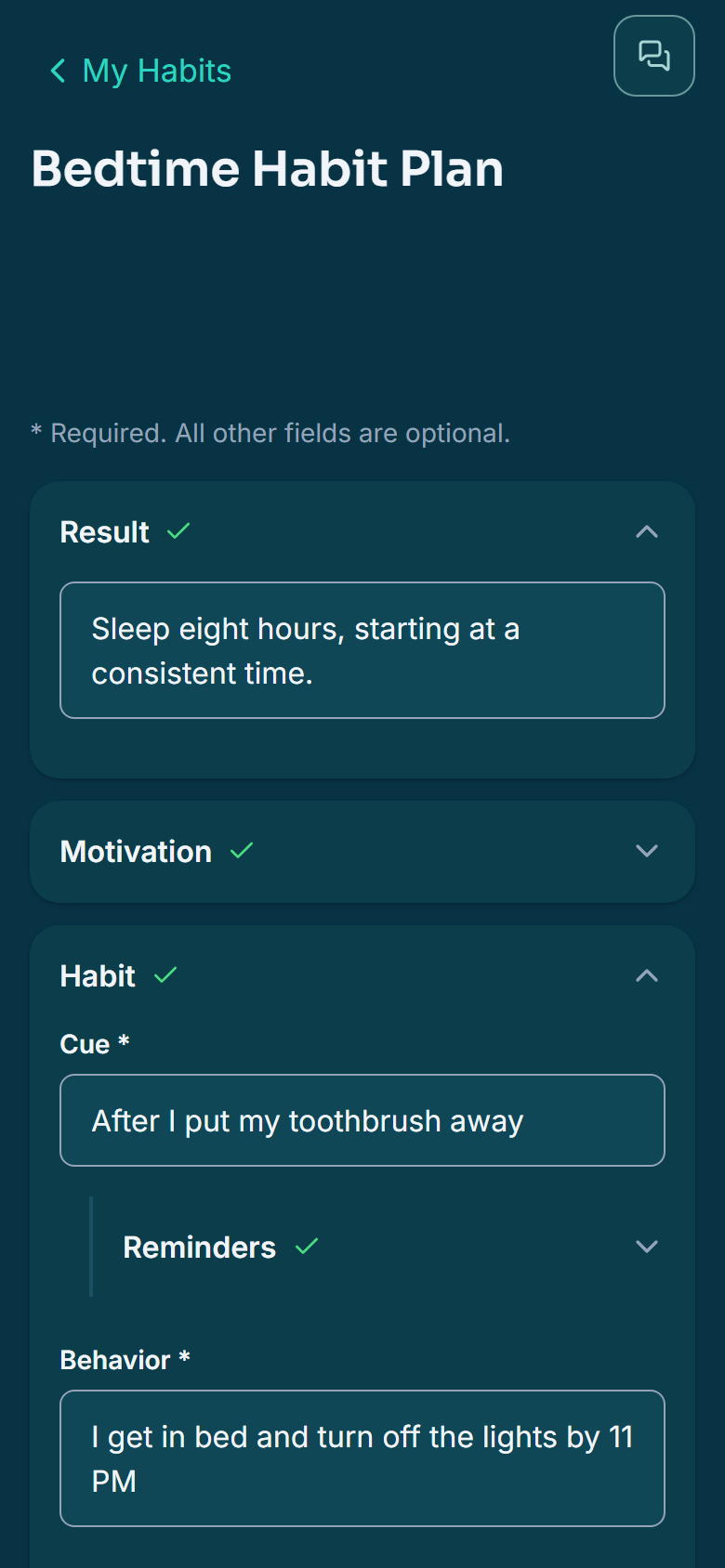
You tell your coach the result you’d like. Together you drill down to make it specific. “I want to sleep better” becomes “sleep eight hours, starting at a consistent time.”
The result is what you want; the behavior is what you’ll do about it. Sleeping eight hours becomes “lights out by eleven.” One behavior may be enough; bigger results take more than one.
Defining the behavior would be enough if your life were simple. But you have distractions, responsibilities, and habits already in place: the late email, the kid who won’t settle, the show you always watch. Your coach asks what actually gets in the way, then you plan around it or remove it.
The behavior becomes a habit when it’s pinned to a cue you’ll notice: “If it’s 10:30 PM, I get ready for bed and brush my teeth. After I put my toothbrush away, I get in bed and turn off the lights by 11:00 PM.”
You start with a setup plan:
Set Do Not Disturb for 9:00 PM
Set a ready-for-bed reminder for 10:30 PM
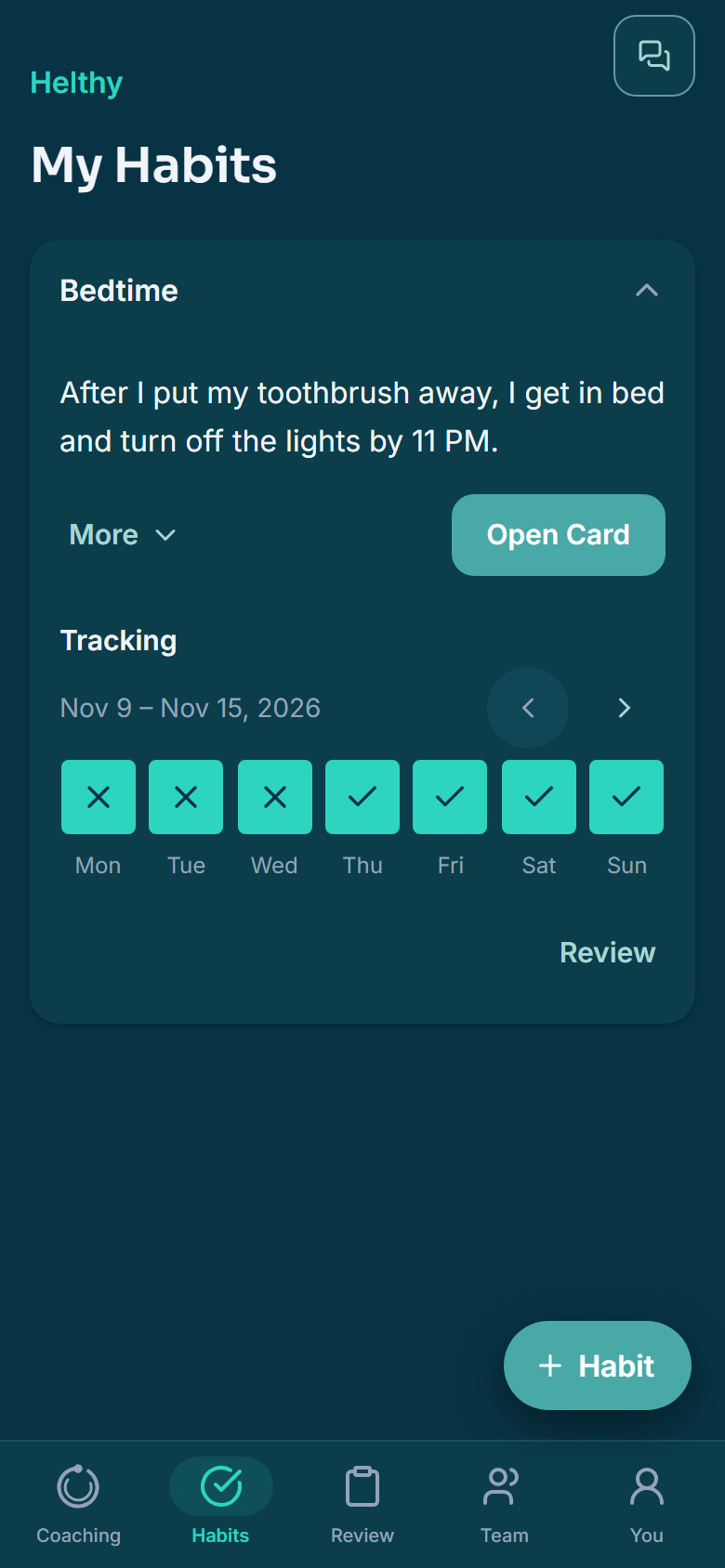
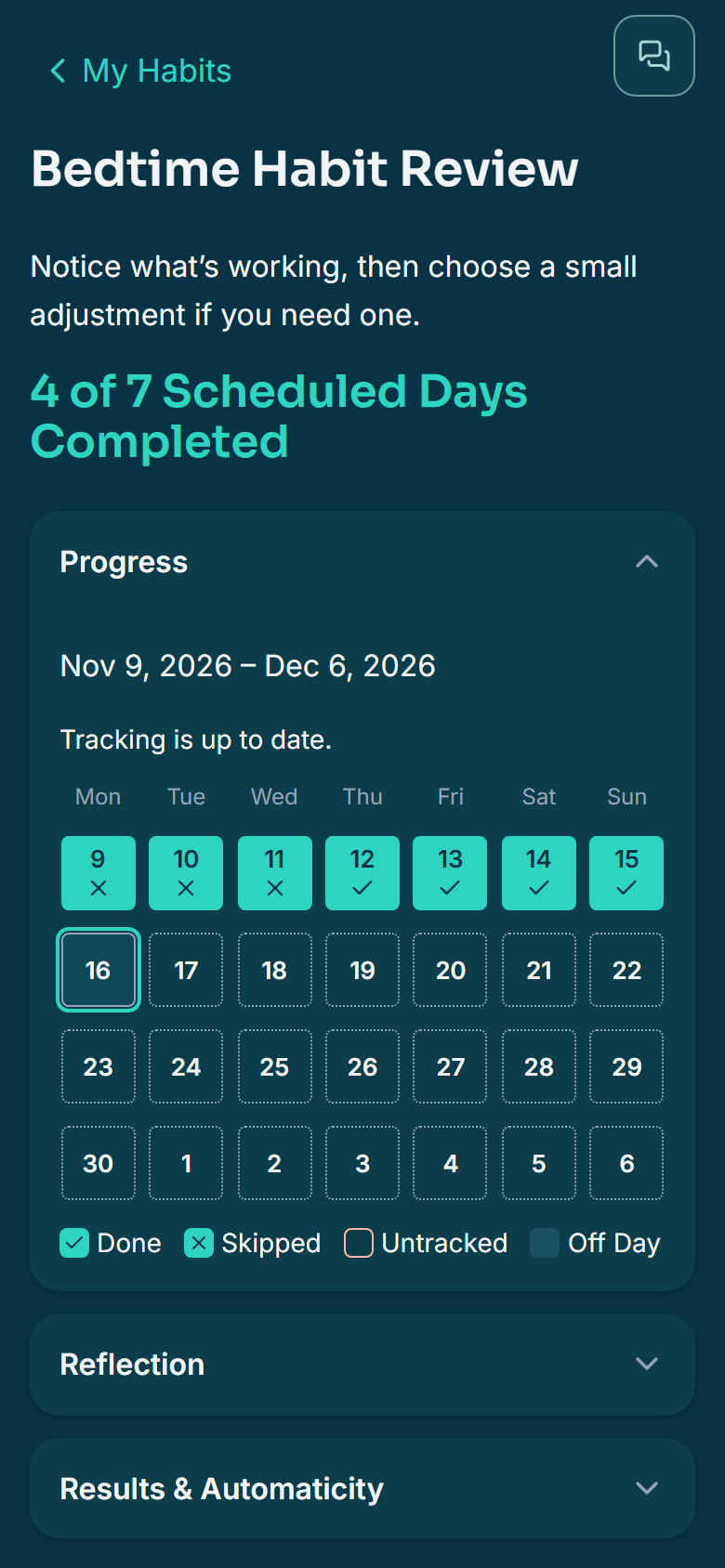
Four nights out of seven, you’re in bed by eleven, up from one. That’s the reward; you don’t need a badge. If you made progress, stay the course; if not, revise the habit or the plan.
Sleeping well is your new normal. What’s next?
Each step is grounded in research.
Set the Result. Across 141 randomized trials, setting a goal improved behavior on its own, separate from whatever else the intervention included (Epton et al., 2017).
Define the Behavior. Across the same 141 trials, goals about behavior and goals about outcomes both changed behavior, and each had slightly more effect on the thing it named (Epton et al., 2017). That is why Helthy sets both.
Name the Barriers. Planning for anticipated obstacles worked better than planning the behavior alone, and best when someone helped form the plans (Kwasnicka et al., 2013). Barriers can also be removed rather than planned around: adding friction to the unhealthy option and reducing it for the healthy one (Wood & Neal, 2016).
Plan the Habit. Across 642 controlled tests, effects measured six or more months after the plan was formed were equivalent to effects measured within the first week, with no decline as the follow-up interval lengthened, unlike motivational interventions, whose impact typically dissipates over time (Sheeran et al., 2025). A behavior happens only when motivation, ability, and a prompt arrive at the same moment, which is why the habit is small and tied to something already in your day (Fogg, 2009). Automaticity then builds with repetition, anywhere from 18 to 254 days, a median of 66 among those who got there (Lally et al., 2010).
Review the Result. Across 138 trials with nearly 20,000 people, tracking progress raised the odds of reaching the goal, and it worked better when the results were written down, and better again when someone else saw them (Harkin et al., 2016).
Live the Result. Interventions built on information or incentives work at first, but the effect fades once they end. Interventions that build habit — repetition, stable cues, reward — are the ones that endure (Wood & Neal, 2016).
You and your coach define the habit and build the plan in a live consult. The Helthy app gets you ready for that consult, and the result is your Habit Plan. The app reminds you of your habit, tracks it, and lets you review your progress and adjust the plan if needed. Start with one habit, then build on it.
For Your Practice In Development
Your expertise isn’t the bottleneck. Follow-through is. We’re building Helthy Practice to turn your advice into an implementation intention, a format whose effect on behavior is as strong six months on as it is in the first week, and to show you what happens between visits.
Across 642 controlled tests, effects measured six or more months after the plan was formed were equivalent to effects measured within the first week, with no decline as the follow-up interval lengthened, unlike motivational interventions, whose impact typically dissipates over time (Sheeran et al., 2025).
Complained of poor recovery and binge eating, which I suspect is related to poor sleep.
Develop habits to improve sleep.
If it’s 9 PM, I close my work laptop.
If it’s 10:30 PM, I get ready for bed and brush my teeth. After I put my toothbrush away, I get in bed and turn off the lights by 11 PM.
Configure Do Not Disturb for 9 PM
Set a ready-for-bed reminder for 10:30
Four nights out of seven, in bed by eleven.
Over the week, Jordan’s tracked bedtime moves earlier, from 12:15 AM on Monday to 10:45 PM on Sunday.
We’re still building Helthy, and we’re asking what makes habit building hard for people and the professionals who guide them. The survey takes about seven minutes, and finishing it puts you on the early access list.
No spam. We’ll email you when Helthy is ready.
Helthy app development is led by Howard Kiewe in Toronto, Canada.

Last updated: August 24, 2026
Helthy is in development. Right now this site does one thing: it asks people what makes health habits hard, so that what gets built is shaped by real answers rather than assumptions.
This page explains what we collect when you answer that survey, who else touches it, how long we keep it, and what you can ask us to do about it. We don’t sell your information, and we won’t.
Your survey answers. What you tell us about your health goals, what has stopped you before, and what you’d want from a habit coach. This is the point of the survey — it decides what gets built.
Your email address, if you give it. It’s optional. Every question that asks for it can be skipped, and skipping it doesn’t change anything else. If you give it, we use it to tell you when Helthy is ready, to let you know when we open our coaching program, and occasionally to follow up on something you said. Nothing else. Every message we send has an unsubscribe link that works.
Where you came from. If you arrived through a tagged link — from a forum, a post, a newsletter — the link carries a short source tag. We use it to understand which communities the answers came from, so we can tell whether we’re hearing from a broad group or a narrow one.
Anonymous usage statistics. We measure which parts of this page people read and where they stop, so we can tell whether the page is doing its job. This is measured without cookies and without identifying you.
This site sets no cookies and runs no advertising. There’s no consent banner because there’s nothing to consent to.
We process your information on the basis of your consent, given when you choose to submit the survey. You can withdraw it at any time — see Your rights below. Withdrawing consent doesn’t affect anything we did with your information before you withdrew it.
Answering is entirely voluntary. There’s no consequence to not answering, and no part of the site is withheld if you don’t.
We use a small number of services to run this site. They process information on our instructions only, and none of them may use it for their own purposes.
| Service | What it does | Where it stores data |
|---|---|---|
| Tally | Runs the survey and stores responses | European Union (Frankfurt) |
| Carrd | Hosts this website | United States |
| PostHog | Anonymous usage statistics | European Union (Frankfurt) |
| Sends the confirmation and launch emails | United States |
We’ll keep this list current. If it changes, this page changes with it.
Your survey answers are stored in the European Union. This website is hosted in the United States, and the emails we send you are sent through Google, also in the United States — so if you give us your email address, that address is transferred to and stored in the United States.
We also keep working copies of the answers in Canada, where we are, for analysis. Those copies have the email addresses removed, so they can’t be traced back to anyone.
If you’re in the EU or UK, this means your email address leaves your jurisdiction. We rely on the standard contractual clauses in our agreements with those providers to protect it. You can decline this simply by not giving us your email address; your survey answers stay in the EU either way.
Two different things, two different clocks.
Answers with your email attached — kept until Helthy launches, or twenty-four months from when you answered, whichever comes first. At that point we remove the email address and anything else that identifies you.
De-identified answers — once your email and other identifying details are removed, the answers stay. We can’t tell who gave them, and they stop being personal information at that point. We keep them because a picture of what made habits hard in 2026 stays useful long after that, and it can’t be reconstructed later. The working copies we analyse are always this kind.
Your email address — kept until you ask us to remove it, or until you unsubscribe from the launch notification.
You can ask us to delete any of it sooner. See below.
Whatever country you’re in, we’ll honour these:
One email address handles all of these: [email protected]. We’ll respond within 30 days. We may need to confirm you are who you say you are before acting on a request, which usually means checking the email address the request comes from against the one on the response.
No automated decision-making. Nothing here makes automated decisions about you.
Survey responses are encrypted in transit and at rest where they are collected and stored. The de-identified working copies we analyse carry no email addresses, so there is nothing in them to link an answer to a person. Access is limited to the people who need it — currently one person. We collect as little as possible, which is the only security measure that never fails.
If we’ve mishandled your information, tell us first — [email protected] — and we’ll try to put it right.
If you’re not satisfied, you can complain to the Office of the Privacy Commissioner of Canada at priv.gc.ca. If you’re in the EU or UK, you can complain to your own national data protection authority instead.
We’ll update this page as Helthy changes, and the date at the top will change with it. If something significant changes and we have your email, we’ll tell you.
Howard Kiewe is accountable for how Helthy handles your information. Questions, requests and complaints all go to the same place:
Howard Kiewe · Helthy 408 Catharine St N, Hamilton, ON L8L 4T6Adapted from the 37signals privacy policy, used under CC BY 4.0. Substantially rewritten and reduced; 37signals does not endorse this adaptation.


